
 Intelligent monitoring and predictive maintenance functions are important innovations in preventing shutdowns of modern electrical cabinet air conditioners. The system integrated with Internet of Things sensors can monitor more than 20 parameters in real time, such as refrigerant pressure, compressor operating current and filter clogging degree. When the data deviation exceeds the preset threshold (such as the current fluctuation exceeding the normal value by 15%), the system will issue a warning 7 days in advance, enabling the maintenance team to intervene in a planned manner, converting passive maintenance into planned maintenance and reducing the probability of unexpected downtime by 90%. For instance, Bosch Rexroth's predictive maintenance platform deployed in its automated factory successfully reduced the mean time to repair (MTTR) from 4 hours to 30 minutes by analyzing air conditioning operation data.
From the perspective of return on investment, installing electrical cabinet air conditioners is a highly efficient risk mitigation strategy. A high-efficiency air conditioner with an initial cost of approximately 8,000 yuan is expected to prevent downtime losses of up to 500,000 yuan within its 10-year life cycle, with an investment return rate exceeding 600%. In contrast, a direct revenue loss and restart cost for a medium-sized manufacturing enterprise caused by an 8-hour production line shutdown may exceed 200,000 yuan. For instance, in 2022, a certain auto parts manufacturer had its entire production line shut down for 12 hours due to overheating of the servo driver, resulting in a loss of over 1 million yuan. However, the total cost of installing an air conditioning system afterwards was only 150,000 yuan. This proactive temperature control strategy has raised equipment availability from the industry average of 95% to over 99.5%, greatly ensuring operational continuity, production capacity and profits.
Intelligent monitoring and predictive maintenance functions are important innovations in preventing shutdowns of modern electrical cabinet air conditioners. The system integrated with Internet of Things sensors can monitor more than 20 parameters in real time, such as refrigerant pressure, compressor operating current and filter clogging degree. When the data deviation exceeds the preset threshold (such as the current fluctuation exceeding the normal value by 15%), the system will issue a warning 7 days in advance, enabling the maintenance team to intervene in a planned manner, converting passive maintenance into planned maintenance and reducing the probability of unexpected downtime by 90%. For instance, Bosch Rexroth's predictive maintenance platform deployed in its automated factory successfully reduced the mean time to repair (MTTR) from 4 hours to 30 minutes by analyzing air conditioning operation data.
From the perspective of return on investment, installing electrical cabinet air conditioners is a highly efficient risk mitigation strategy. A high-efficiency air conditioner with an initial cost of approximately 8,000 yuan is expected to prevent downtime losses of up to 500,000 yuan within its 10-year life cycle, with an investment return rate exceeding 600%. In contrast, a direct revenue loss and restart cost for a medium-sized manufacturing enterprise caused by an 8-hour production line shutdown may exceed 200,000 yuan. For instance, in 2022, a certain auto parts manufacturer had its entire production line shut down for 12 hours due to overheating of the servo driver, resulting in a loss of over 1 million yuan. However, the total cost of installing an air conditioning system afterwards was only 150,000 yuan. This proactive temperature control strategy has raised equipment availability from the industry average of 95% to over 99.5%, greatly ensuring operational continuity, production capacity and profits.
Default
How does air conditioning for electrical cabinets prevent downtime?
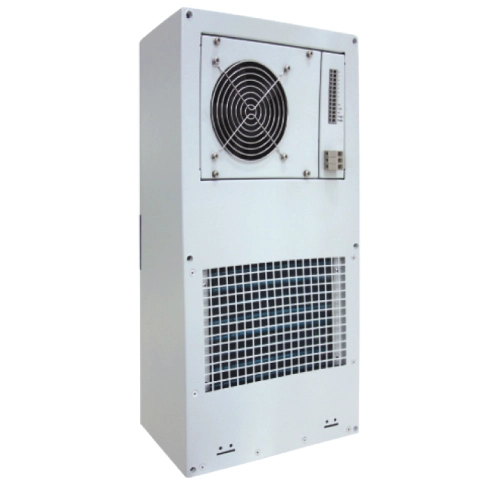
The electrical cabinet air conditioner directly prevents unexpected shutdowns caused by overheating by stably maintaining the temperature inside the cabinet at the rated value (for example, below 35 degrees Celsius). Research shows that the failure rate of electronic components increases exponentially when the temperature exceeds 55 degrees Celsius. For every 10 degrees Celsius increase in temperature, the failure rate of components doubles. For instance, a frequency converter with a rated power of 15 kilowatts operating at a cabinet temperature of 65 degrees Celsius may have its lifespan shortened from 10 years to just 2 years, and the probability of failure increases by 300%. An 800-watt air conditioning for electrical cabinets can effectively reduce the internal temperature by 20 degrees Celsius and lower the failure rate of key equipment such as PLC by more than 40%, thus ensuring the continuous operation of the production line. It can avoid an average of three unplanned shutdowns each year, with each loss exceeding 50,000 yuan.
From the perspective of thermal management solutions, electrical cabinet air conditioners prevent the risks of condensation and short circuits by precisely controlling humidity parameters. When the environmental humidity exceeds 60%, the risk of circuit board corrosion will increase by 50%. When the humidity is below 30%, it may cause static discharge, with the voltage reaching up to 15,000 volts, damaging sensitive chips. Professional electrical cabinet air conditioners can stably control the humidity within the golden range of 40% to 60%. For instance, in the application of chemical plants in coastal areas, this function has reduced the failure events caused by moisture by 70%. According to the case study of Schneider Electric, after installing a sealed cooling system for its key distribution cabinets, the humidity-related downtime was reduced from 50 hours per year to nearly zero hours.
Intelligent monitoring and predictive maintenance functions are important innovations in preventing shutdowns of modern electrical cabinet air conditioners. The system integrated with Internet of Things sensors can monitor more than 20 parameters in real time, such as refrigerant pressure, compressor operating current and filter clogging degree. When the data deviation exceeds the preset threshold (such as the current fluctuation exceeding the normal value by 15%), the system will issue a warning 7 days in advance, enabling the maintenance team to intervene in a planned manner, converting passive maintenance into planned maintenance and reducing the probability of unexpected downtime by 90%. For instance, Bosch Rexroth's predictive maintenance platform deployed in its automated factory successfully reduced the mean time to repair (MTTR) from 4 hours to 30 minutes by analyzing air conditioning operation data.
From the perspective of return on investment, installing electrical cabinet air conditioners is a highly efficient risk mitigation strategy. A high-efficiency air conditioner with an initial cost of approximately 8,000 yuan is expected to prevent downtime losses of up to 500,000 yuan within its 10-year life cycle, with an investment return rate exceeding 600%. In contrast, a direct revenue loss and restart cost for a medium-sized manufacturing enterprise caused by an 8-hour production line shutdown may exceed 200,000 yuan. For instance, in 2022, a certain auto parts manufacturer had its entire production line shut down for 12 hours due to overheating of the servo driver, resulting in a loss of over 1 million yuan. However, the total cost of installing an air conditioning system afterwards was only 150,000 yuan. This proactive temperature control strategy has raised equipment availability from the industry average of 95% to over 99.5%, greatly ensuring operational continuity, production capacity and profits.
Intelligent monitoring and predictive maintenance functions are important innovations in preventing shutdowns of modern electrical cabinet air conditioners. The system integrated with Internet of Things sensors can monitor more than 20 parameters in real time, such as refrigerant pressure, compressor operating current and filter clogging degree. When the data deviation exceeds the preset threshold (such as the current fluctuation exceeding the normal value by 15%), the system will issue a warning 7 days in advance, enabling the maintenance team to intervene in a planned manner, converting passive maintenance into planned maintenance and reducing the probability of unexpected downtime by 90%. For instance, Bosch Rexroth's predictive maintenance platform deployed in its automated factory successfully reduced the mean time to repair (MTTR) from 4 hours to 30 minutes by analyzing air conditioning operation data.
From the perspective of return on investment, installing electrical cabinet air conditioners is a highly efficient risk mitigation strategy. A high-efficiency air conditioner with an initial cost of approximately 8,000 yuan is expected to prevent downtime losses of up to 500,000 yuan within its 10-year life cycle, with an investment return rate exceeding 600%. In contrast, a direct revenue loss and restart cost for a medium-sized manufacturing enterprise caused by an 8-hour production line shutdown may exceed 200,000 yuan. For instance, in 2022, a certain auto parts manufacturer had its entire production line shut down for 12 hours due to overheating of the servo driver, resulting in a loss of over 1 million yuan. However, the total cost of installing an air conditioning system afterwards was only 150,000 yuan. This proactive temperature control strategy has raised equipment availability from the industry average of 95% to over 99.5%, greatly ensuring operational continuity, production capacity and profits.