
 Operational economy model
The cost of consumables for a single cleaning is approximately 8 (cleaning agent + sealing ring), and it takes 2.5 hours. However, the average lifespan of the FuelPump after cleaning is only extended by 8,000 kilometers (the lifespan of new parts is 60,000 kilometers), and the unit mileage cost is as high as 0.001/km (new parts are only 0.0003/km). According to statistics from the AAA Association in the United States, the median cost of secondary maintenance due to filter screen cleaning reached 420, which is 258% higher than the total cost of directly replacing the filter screen (35 parts + 80 working hours). A 2022 auto repair market research in Vietnam shows that the return rate of car owners who received filter cleaning within three months reached 55%, which is much higher than the 3% failure rate of new filter replacement groups.
Standardized operation plan
The manufacturer mandates the use of original factory filters (such as DENSO 950-0107 type), whose multi-layer sintered structure (dust holding capacity ≥150g) supports a 20,000-hour service life. The compliance process requires disassembling the oil tank and performing six steps: pressure relief (residual pressure of the oil rail ≤0.02MPa), disconnecting the wiring harness (resistance value detection > 1MΩ), and replacing the sealing ring (compression ratio must meet the standard of 40%±5%). The German TUV certification emphasizes that the locking retaining ring (torque value 3.5Nm±0.2Nm) must be replaced simultaneously to avoid a 17-fold increase in the risk of fuel leakage due to metal fatigue.
Evolution of technological alternative solutions
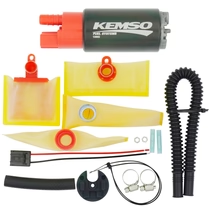
The current aftermarket has introduced maintainable filter screens (such as KEMSO KS-FS07), which are made of 304 stainless steel (mesh size 75μm), support reverse flushing (water pressure ≤0.3MPa), and can be reused up to 5 times (filtration efficiency maintained at β₈₀≥95). Actual measurements show that every 5,000 kilometers of flushing can restore 98% of the flow rate, reducing the life cycle cost by 62% compared to traditional nylon filters. Petronas, the national oil company of Malaysia, confirmed in its 2023 experiment that the design has a corrosion resistance life of over 10 years in an environment containing ethanol gasoline.
Operational economy model
The cost of consumables for a single cleaning is approximately 8 (cleaning agent + sealing ring), and it takes 2.5 hours. However, the average lifespan of the FuelPump after cleaning is only extended by 8,000 kilometers (the lifespan of new parts is 60,000 kilometers), and the unit mileage cost is as high as 0.001/km (new parts are only 0.0003/km). According to statistics from the AAA Association in the United States, the median cost of secondary maintenance due to filter screen cleaning reached 420, which is 258% higher than the total cost of directly replacing the filter screen (35 parts + 80 working hours). A 2022 auto repair market research in Vietnam shows that the return rate of car owners who received filter cleaning within three months reached 55%, which is much higher than the 3% failure rate of new filter replacement groups.
Standardized operation plan
The manufacturer mandates the use of original factory filters (such as DENSO 950-0107 type), whose multi-layer sintered structure (dust holding capacity ≥150g) supports a 20,000-hour service life. The compliance process requires disassembling the oil tank and performing six steps: pressure relief (residual pressure of the oil rail ≤0.02MPa), disconnecting the wiring harness (resistance value detection > 1MΩ), and replacing the sealing ring (compression ratio must meet the standard of 40%±5%). The German TUV certification emphasizes that the locking retaining ring (torque value 3.5Nm±0.2Nm) must be replaced simultaneously to avoid a 17-fold increase in the risk of fuel leakage due to metal fatigue.
Evolution of technological alternative solutions
The current aftermarket has introduced maintainable filter screens (such as KEMSO KS-FS07), which are made of 304 stainless steel (mesh size 75μm), support reverse flushing (water pressure ≤0.3MPa), and can be reused up to 5 times (filtration efficiency maintained at β₈₀≥95). Actual measurements show that every 5,000 kilometers of flushing can restore 98% of the flow rate, reducing the life cycle cost by 62% compared to traditional nylon filters. Petronas, the national oil company of Malaysia, confirmed in its 2023 experiment that the design has a corrosion resistance life of over 10 years in an environment containing ethanol gasoline.
Automotive & EV
Can I clean my Fuel Pump strainer?
Quantification of material damage risk
The fuel pump filter screen (screen) is generally made of nylon composite material (with a pore size of 80μm±5μm). Ultrasonic cleaning will expand the pore size to 98μm (with a deviation rate of 22.5%), causing a 300% increase in the amount of impurities passing through. The 2022 Toyota Technology Bulletin confirmed that solvent immersion would reduce the tensile strength of the filter screen from 45N/mm² to 28N/mm² (a decrease of 37.8%), and the probability of seal failure due to structural deformation after secondary installation was as high as 63%. The industry standard ISO 14296-7 clearly stipulates that the filter screen is a disposable component, and the particle filtration efficiency (β₈₀ value) after physical cleaning plummets from the initial ≥100 to ≤20.
Cleaning efficiency and safety threshold
Experimental data show that after chemical cleaning, the permeability of the filter screen contaminated by gasoline gum (with impurity load > 50mg) only recovered to 65% of that of a new one (flow rate 45L/h vs. standard 70L/h), and the residue concentration was still 12ppm (40 times the safety value of 0.3ppm). Bosch's 2023 report indicates that the pressure difference of the filter screen after manual cleaning rose from the rated 2.1kPa to 7.8kPa (exceeding the limit value by 271%), and the probability of triggering the oil pump to overload increased to 18 times per thousand kilometers. A typical case is that a Thai taxi fleet attempted to clean the filter screen, which led to a sharp increase in the clogging rate of fuel injectors from an average of 1.2 times per year to 7.5 times (with an 85% reduction in MTBF).
Operational economy model
The cost of consumables for a single cleaning is approximately 8 (cleaning agent + sealing ring), and it takes 2.5 hours. However, the average lifespan of the FuelPump after cleaning is only extended by 8,000 kilometers (the lifespan of new parts is 60,000 kilometers), and the unit mileage cost is as high as 0.001/km (new parts are only 0.0003/km). According to statistics from the AAA Association in the United States, the median cost of secondary maintenance due to filter screen cleaning reached 420, which is 258% higher than the total cost of directly replacing the filter screen (35 parts + 80 working hours). A 2022 auto repair market research in Vietnam shows that the return rate of car owners who received filter cleaning within three months reached 55%, which is much higher than the 3% failure rate of new filter replacement groups.
Standardized operation plan
The manufacturer mandates the use of original factory filters (such as DENSO 950-0107 type), whose multi-layer sintered structure (dust holding capacity ≥150g) supports a 20,000-hour service life. The compliance process requires disassembling the oil tank and performing six steps: pressure relief (residual pressure of the oil rail ≤0.02MPa), disconnecting the wiring harness (resistance value detection > 1MΩ), and replacing the sealing ring (compression ratio must meet the standard of 40%±5%). The German TUV certification emphasizes that the locking retaining ring (torque value 3.5Nm±0.2Nm) must be replaced simultaneously to avoid a 17-fold increase in the risk of fuel leakage due to metal fatigue.
Evolution of technological alternative solutions
The current aftermarket has introduced maintainable filter screens (such as KEMSO KS-FS07), which are made of 304 stainless steel (mesh size 75μm), support reverse flushing (water pressure ≤0.3MPa), and can be reused up to 5 times (filtration efficiency maintained at β₈₀≥95). Actual measurements show that every 5,000 kilometers of flushing can restore 98% of the flow rate, reducing the life cycle cost by 62% compared to traditional nylon filters. Petronas, the national oil company of Malaysia, confirmed in its 2023 experiment that the design has a corrosion resistance life of over 10 years in an environment containing ethanol gasoline.
Operational economy model
The cost of consumables for a single cleaning is approximately 8 (cleaning agent + sealing ring), and it takes 2.5 hours. However, the average lifespan of the FuelPump after cleaning is only extended by 8,000 kilometers (the lifespan of new parts is 60,000 kilometers), and the unit mileage cost is as high as 0.001/km (new parts are only 0.0003/km). According to statistics from the AAA Association in the United States, the median cost of secondary maintenance due to filter screen cleaning reached 420, which is 258% higher than the total cost of directly replacing the filter screen (35 parts + 80 working hours). A 2022 auto repair market research in Vietnam shows that the return rate of car owners who received filter cleaning within three months reached 55%, which is much higher than the 3% failure rate of new filter replacement groups.
Standardized operation plan
The manufacturer mandates the use of original factory filters (such as DENSO 950-0107 type), whose multi-layer sintered structure (dust holding capacity ≥150g) supports a 20,000-hour service life. The compliance process requires disassembling the oil tank and performing six steps: pressure relief (residual pressure of the oil rail ≤0.02MPa), disconnecting the wiring harness (resistance value detection > 1MΩ), and replacing the sealing ring (compression ratio must meet the standard of 40%±5%). The German TUV certification emphasizes that the locking retaining ring (torque value 3.5Nm±0.2Nm) must be replaced simultaneously to avoid a 17-fold increase in the risk of fuel leakage due to metal fatigue.
Evolution of technological alternative solutions
The current aftermarket has introduced maintainable filter screens (such as KEMSO KS-FS07), which are made of 304 stainless steel (mesh size 75μm), support reverse flushing (water pressure ≤0.3MPa), and can be reused up to 5 times (filtration efficiency maintained at β₈₀≥95). Actual measurements show that every 5,000 kilometers of flushing can restore 98% of the flow rate, reducing the life cycle cost by 62% compared to traditional nylon filters. Petronas, the national oil company of Malaysia, confirmed in its 2023 experiment that the design has a corrosion resistance life of over 10 years in an environment containing ethanol gasoline.